
Last Updated: 3 weeks ago
BOGOR – The Aquaculture Study Program of the Faculty of Agriculture (FAPERTA), Djuanda University (UNIDA), conducted a field practicum for the Planktonology course at Farm Koi Kahuripan (FKK) in Bogor Regency, West Java, on May 11, 2026. This hands-on activity aimed to enhance students' understanding of plankton sampling techniques and their crucial role in aquaculture.
Plankton are microscopic organisms that drift in water bodies and play a vital role in aquatic ecosystems. In planktonology studies, they are classified into phytoplankton and zooplankton, each serving distinct ecological functions. Phytoplankton act as primary producers through photosynthesis, while zooplankton serve as primary consumers in the aquatic food chain. Consequently, the presence of plankton heavily influences aquatic productivity and ecosystem balance.
In aquatic ecology, plankton also serve as biological indicators to assess water fertility and quality. Their abundance and composition are driven by various environmental factors, including light intensity, depth, transparency, temperature, and nutrient availability. Therefore, a comprehensive understanding of plankton is essential. Furthermore, plankton are indispensable in aquaculture as they serve as natural feed.
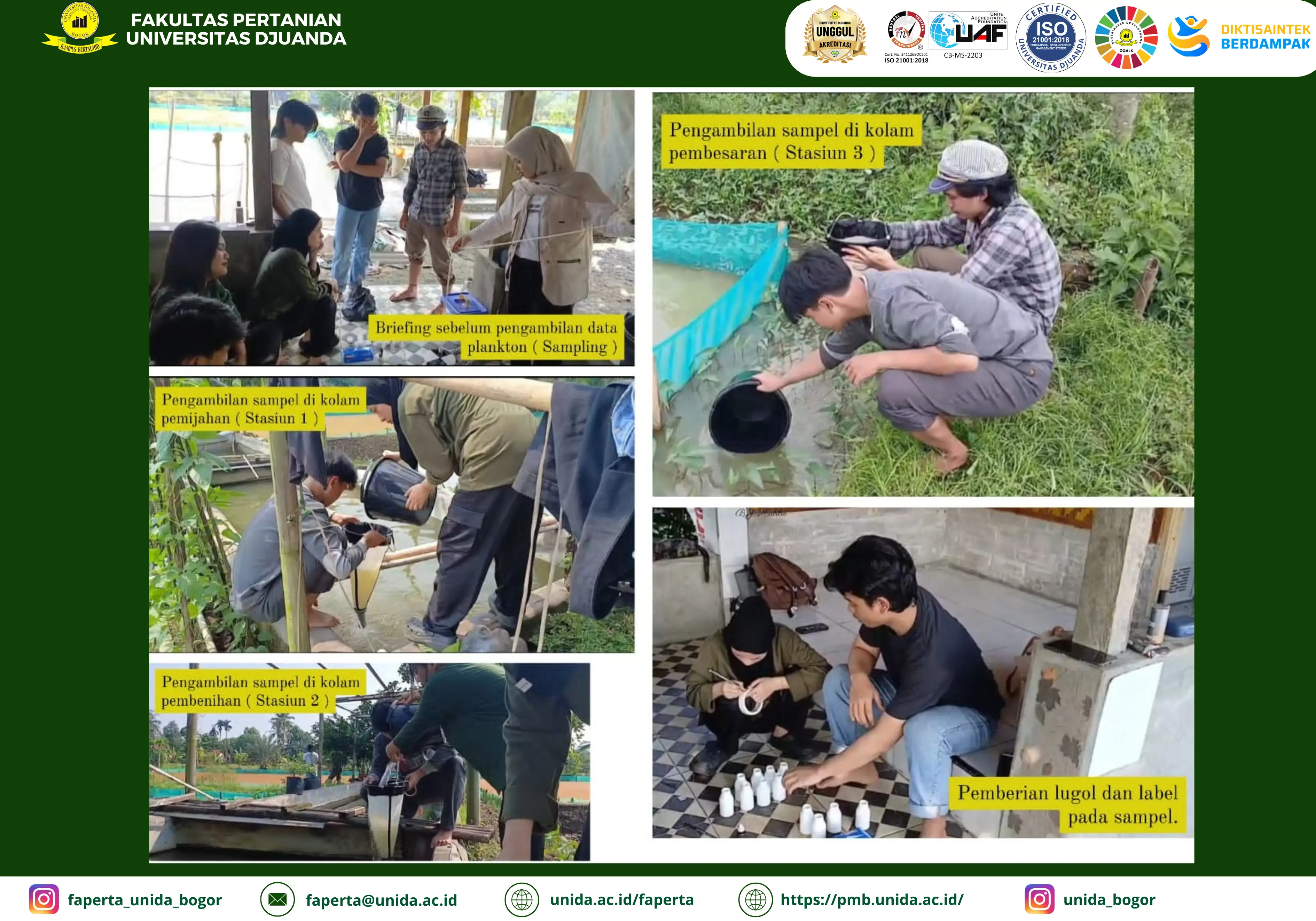
The practicum began with a briefing on plankton sampling techniques. Sampling was conducted across three observation stations representing different pond types at FKK: Station I in the hatchery pond, Station II in the spawning pond, and Station III in the grow-out pond. At each station, sampling was replicated four times to obtain representative data on the plankton conditions in each pond.
Plankton samples were collected using a plankton net as a filtering tool. The filtered plankton were then transferred into 100 ml sample bottles. Lugol's solution was added to each bottle as a preservative to maintain sample integrity until laboratory analysis. Each bottle was labeled with the station name, sampling point, and replicate number to streamline the data identification process.
Alongside plankton sampling, students measured physical water parameters, specifically depth and transparency. Transparency was measured using a Secchi disk, while depth was measured directly at each observation station. All measurements were systematically recorded as supporting data to analyze the relationship between environmental conditions and plankton presence in the observed ponds.
Through this practicum, students are expected to master plankton sampling methods, water quality measurement techniques, and the correlation between environmental conditions and aquatic plankton presence. Additionally, this activity trains students in fieldwork skills, scientific data logging, and basic analysis of plankton community structures. This activity marks the beginning of subsequent practicum sessions. Wallahu A'lam Bishawab (Siti Maemunah/ A.2410579, 170526-AKU).