
Loading...
Profile

Faculty of Agriculture - UNIDA

History

One of the goals of the Unitary State of the Republic of Indonesia is to educate the nation's life. The PSPIAI Foundation as an institution engaged in education has a responsibility for the progress of the Muslim Ummah. The founder of the Indonesian Center for Islamic Amaliah Development Studies Foundation Lieutenant General TNI Purn. H. Alamsjah Ratu Perwiranegara (Alm) initiated the establishment of the Indonesian Center for Islamic Development Studies Foundation assisted by his relatives on June 3, 1983 on waqf land in Ciawi, Bogor Regency, West Java. Based on the decision of the Indonesian Islamic Development Study Center Foundation number: 083/PSPI/III/87, on March 21, 1987 Djuanda University was established. The name Djuanda was immortalized into the name of the University as a tribute to a National Independence Hero of Sundanese blood, namely Ir. H. Djoeanda Kartawidjaja born in Tasikmalaya on January 14, 1911 who took part in many fields of government in the Republic of Indonesia.

 
Vision:

Becoming an excellent Faculty of Agriculture to educate the life of a nation that is united in tawhid and has international standards
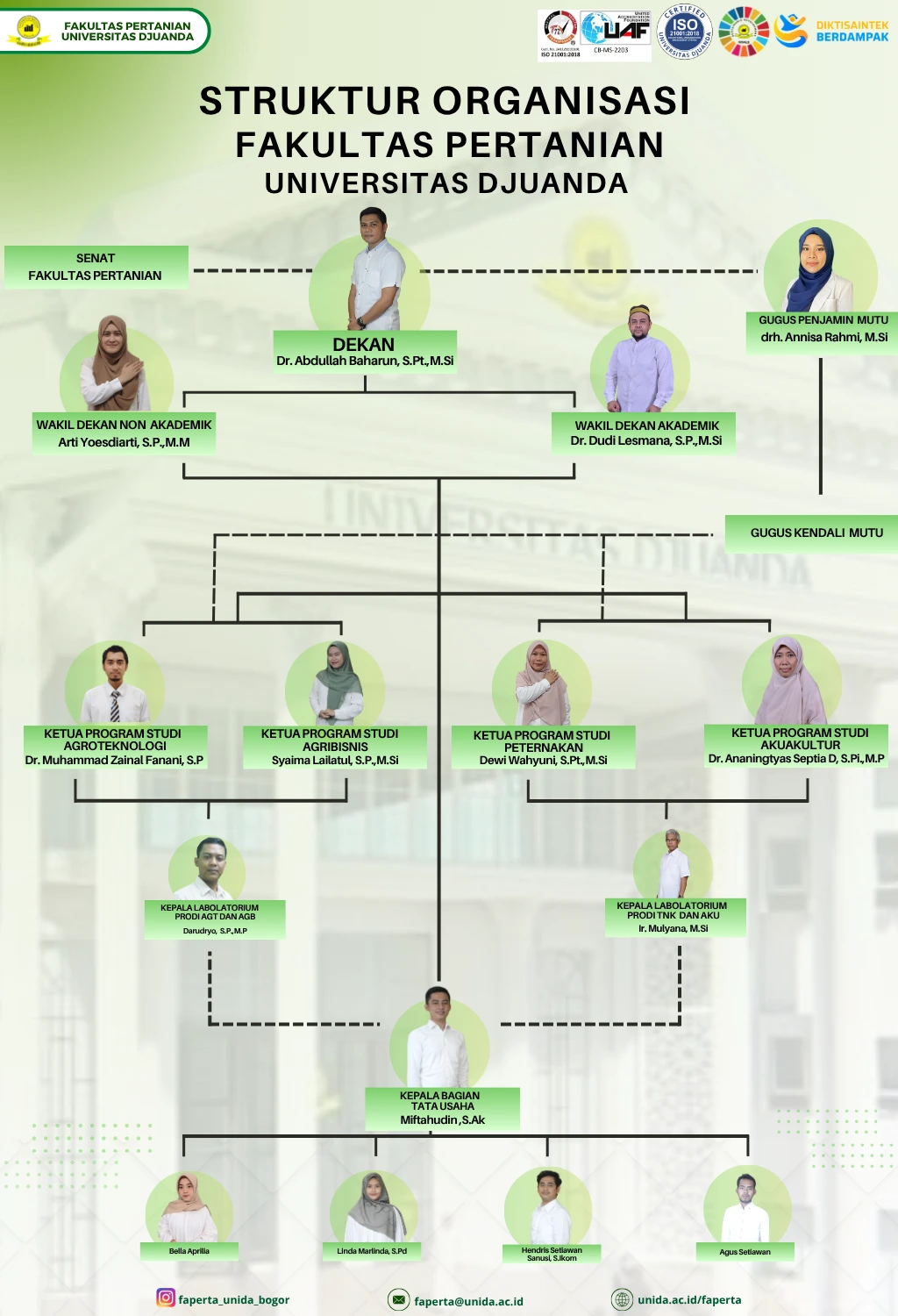
Mission:
  1. Organizing higher education in agriculture that is modern and united in tawhid
  2. Organizing creative and innovative research that is useful for the development of science, business, and industry in the field of agriculture that is united in tawhid.
  3. Organizing community service that is appropriate and right on target in the field of agriculture.
  4. Organizing higher education management with good and correct faculty governance.
  5. Building a campus life that is nuanced in tawhid
Goal:
  1. Organizing higher education in agriculture that is modern and integrated in tawhid.
  2. Organizing creative and innovative research that is useful for the development of science, business, and industry in the field of agriculture that is united in tawhid.
  3. Organizing community service that is appropriate and right on target in the field of agriculture.
  4. Organizing higher education management with good and correct faculty governance.
objective:
  1. Producing graduates who are devout and internationally competitive in the field of agriculture.
  2. Managing university academic facilities in the field of modern and international standard agriculture.
  3. Producing research outputs that are oriented towards the novelty of science, technology, and halal and thayyib agricultural products that benefit the community.
  4. Producing service outputs in the field of agriculture that are solutive, value-added, and improve community welfare.
  5. Making the quality of higher education governance transparent, accountable, independent, equitable, and participatory which is integrated in tawhid.
  6. Realizing the culture of tawhid in every academic and non-academic activity for the people of the Faculty of Agriculture.