
Last Updated: 5 years ago
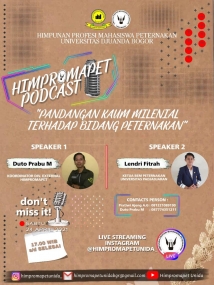
"The Views of Millennials on the Field of Livestock Farming" The External Division Coordinator of the Livestock Student Professional Association (Himpromapet) at Djuanda University Bogor, opened a space for discussion on the current developments and perspectives regarding livestock farming. On this occasion, Duto Prabu, as the External Coordinator, also invited his colleague from Padjadjaran University Bandung, namely Lendri Fitrah, who is currently entrusted as the Chairperson of the Student Executive Board (BEM) of Livestock Farming at Padjadjaran University. In the discussion room, they discussed how the current society often overlooks the field of livestock farming from the perspective of millennials. The future of domestic farming in the millennial era will inevitably involve Generation Y and Z, who are characterized as highly responsive to changes in information. The excellent information absorption capabilities of millennials should be properly managed to have a positive impact on the future development of the livestock farming industry. Duto Prabu asked the Chairperson of BEM Unpad about the expectations in the field of Livestock Farming, and according to Lendri Fitrah, the initial expectations in the field of Livestock Farming revolve around its business potential. "The expectations lie in the business aspect, because ultimately when we understand how to manage the business aspect, it means that is one of our activities to generate income and earn money," said Lendri. The discussion also touched on what attracts millennials to engage in livestock farming business and motivates some of them to study it. According to Lendri, there are significant and open business opportunities in the livestock farming field for millennials to participate in. "It's about competitive competition; livestock farming itself carries a stigma for those who are still unfamiliar, because this is where the significant opportunity lies. If we're willing to get involved, there must be sacrifices, meaning we need to give a little of what we can provide, as in the end, it's income for ourselves," stated Lendri. Lendri's statement was responded to by Duto Prabu, who mentioned that animal husbandry is an engaging and challenging activity for millennials, despite requiring patience and hard, tiring work. "The culture of animal husbandry, which people describe as dirty, smelly, and tiring, is indeed true. When we become 'children of the barn,' we will experience these things. We will definitely get dirty and tired. We will surely scrape together grass and lift additional feed like heavy tofu waste in wet conditions, which can reach 45kg in one sack. But again, what are millennials thinking about if not pursuing results that ultimately turn into business activities and earnings?" said Kang Prabu. During the discussion, Duto Prabu inquired about Lendri's feelings of insecurity or pride, when asked about the field of study and area of expertise. As the views of millennials tend to admire and consider someone great based on their appearance and a modern, up-to-date lifestyle, such as being in a modern business profession or working in an office setting. Lendri responded to this, stating that pride in studying livestock farming should be instilled in him as a student in the Livestock Farming department. "If asked whether I feel insecure or proud, it must be proud. Why? Because what sets us apart is being born into various conditions in this world, with strengths and weaknesses. Here, we can try to optimize our strengths and improve our weaknesses," said Lendri. At the end of the discussion, each millennial asked about the achievements gained from learning and delving into the field of livestock farming. Duto Prabu is already implementing business activities, having opened his own farm, although it's still modest and managed through a collaborative system. "As for me, I'm seeking experience and building my skills from now on. Alhamdulillah, I've started a business in goat farming for Qurban sales and providing meat for Aqiqah and celebrations. Since the capital is still gradual, for large quantities, I still manage it through a cooperative system with a larger farmer," said Duto. In contrast, Lendri Fitrah is still active in the organization he leads and other organizational programs. He is pursuing various academic and practical field targets. However, Lendri stated that a simple achievement he has accomplished is sharing knowledge with the community. "Alhamdulillah, at times, I've had the opportunity to provide some education and enlightenment to the residents, especially in my village. The hope is to motivate people a bit to contribute to self-sufficiency in meat production and other aspects to support food security," said Lendri Fitrah.