
Last Updated: 4 days ago
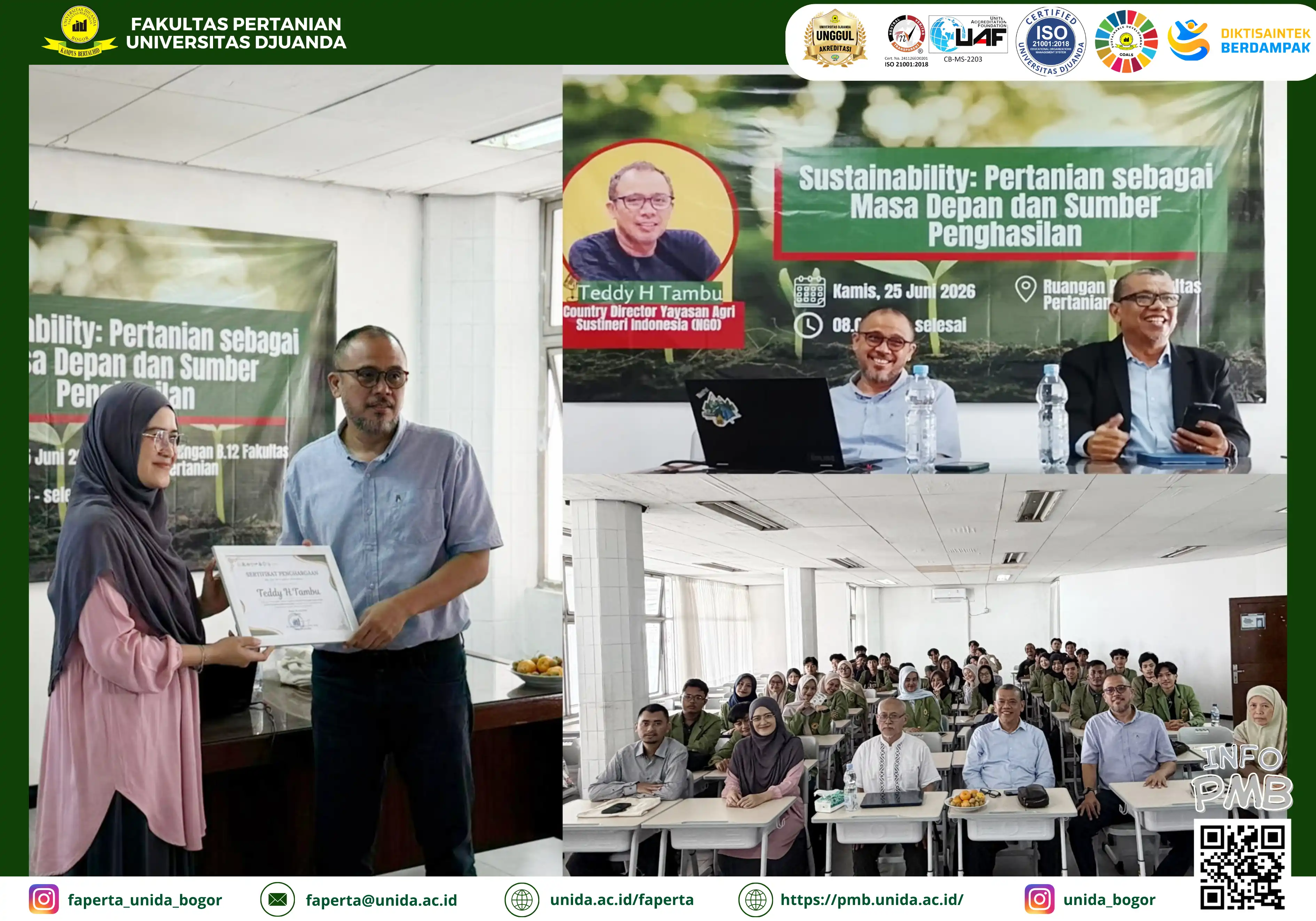
The Agrotechnology Study Program (AGT) of the Faculty of Agriculture (FAPERTA) at Universitas Djuanda (UNIDA) welcomed a national practitioner as part of its Practitioner Teaching Program, held in Room B.312 on Thursday (June 25). The activity forms part of the university’s efforts to strengthen experiential learning while bridging academic knowledge with real-world agricultural practices.
The invited speaker was Teddy H. Tambu, Country Director of Agri Sustineri Indonesia Foundation. In his presentation, entitled “Sustainability: Agriculture as the Future and a Source of Income,” he emphasized the importance of sustainable agriculture as a foundation for food security and economic opportunity.
“Agriculture holds enormous potential for the future. When managed through innovative and sustainable approaches, this sector can become a promising source of income while also providing solutions to various global challenges,” Teddy stated.
He further explained that agriculture is no longer solely focused on food production but has evolved into a strategic sector that contributes to economic development, environmental conservation, and community welfare. According to him, global challenges such as climate change, land degradation, and increasing food demand can only be addressed through sustainable approaches.
The event was attended by students, lecturers, and members of the academic community of FAPERTA UNIDA. Participants demonstrated great enthusiasm during the interactive discussion session, which covered topics ranging from the challenges of modern agriculture to opportunities in sustainable agribusiness and the role of younger generations in transforming the agricultural sector.
In his remarks, the Head of the Agrotechnology Study Program, Dr. Muhammad Zainal Fanani, S.P., emphasized that the Practitioner Teaching Program reflects the department’s commitment to delivering education that is relevant to the needs of the professional world.
“We hope this activity broadens students’ understanding of the realities of today’s agricultural sector. Modern agriculture demands innovation, technological adaptation, and a sustainable mindset to effectively respond to future challenges,” he said.
Appreciation was also expressed by the Vice Dean for Non-Academic Affairs of FAPERTA UNIDA, Arti Yoesdiarti, S.P., M.M. She considered collaboration between academics and practitioners a strategic step toward producing graduates who are well prepared to face the dynamics of the agricultural industry.
“This synergy is essential to strengthening the link and match between higher education and real-world needs. We hope activities like this will continue to become part of our academic culture,” she remarked.
Several Agrotechnology lecturers also attended the event, including Dr. Ir. Arifah Rahayu, M.Si., Dr. Ir. Setyono, M.Si., and Dr. Ir. Askif Pasaribu, M.P.
Through this initiative, FAPERTA UNIDA reaffirmed its commitment to producing highly qualified, innovative, and competitive agricultural professionals. The Practitioner Teaching Program also serves as a concrete step toward building an adaptive, collaborative, and sustainable agricultural education ecosystem.