
Last Updated: 7 months ago
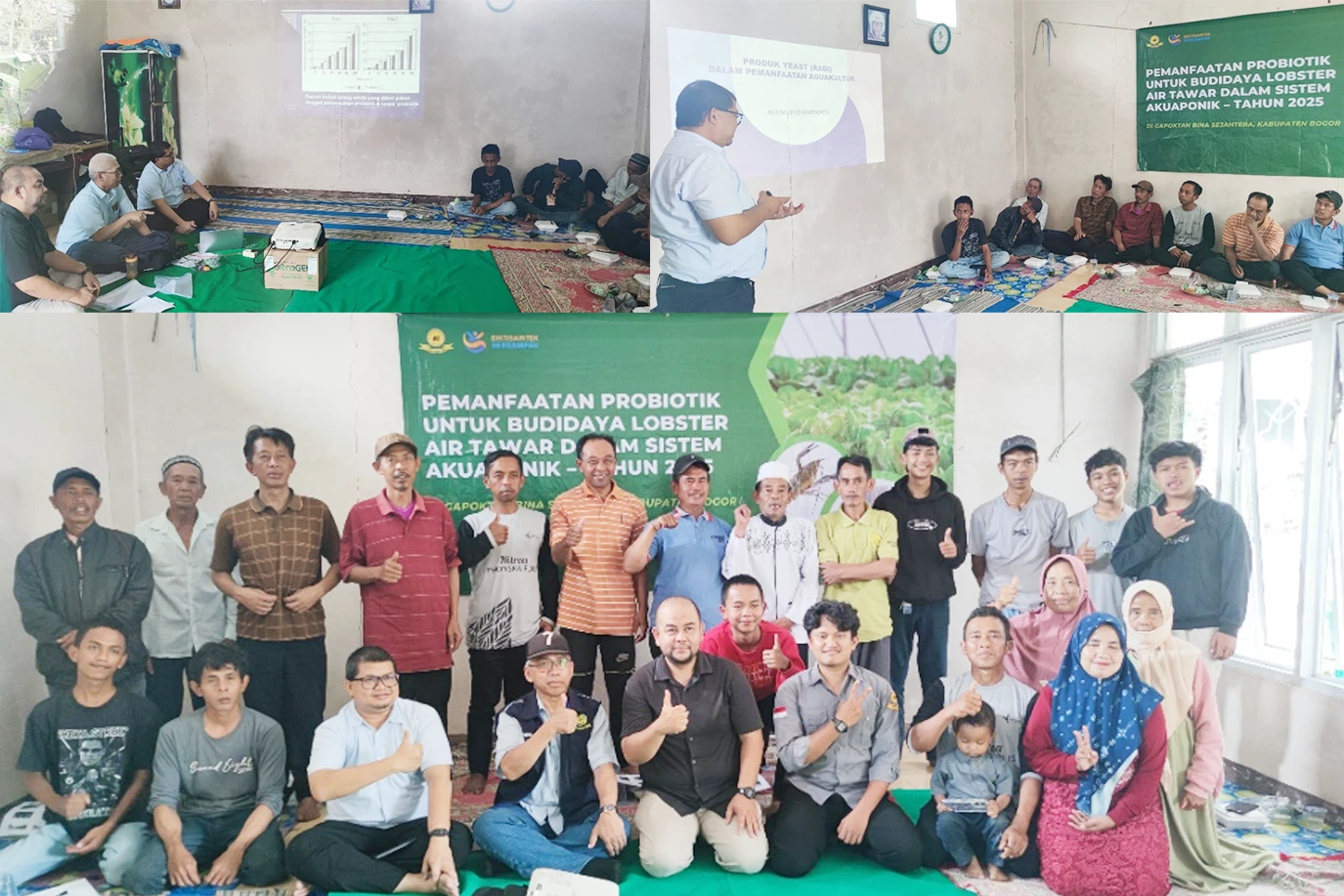
Amid the growing public interest in freshwater lobster farming, the lecturer team of Djuanda University (UNIDA) once again engaged with the community through the Community Partnership Program (PKM) in collaboration with the Bina Sejahtera Farmers Group Association (Gapoktan), Bogor Regency. Carrying the theme “Utilization of Probiotics in Freshwater Lobster Feed with an Aquaponic System”, the program focuses on introducing and applying probiotic technology as an innovative solution to improve lobster farming quality while strengthening the capacity of local farmers.
The PKM activity, led by Ir. Mulyana, M.Si from the Faculty of Agriculture (FAPERTA) UNIDA, addresses the main challenges in farming Cherax quadricarinatus—also known as the Australian red-claw crayfish. Despite its advantages of rapid growth, relatively easy maintenance, and high economic value, freshwater lobster farming often faces obstacles caused by ammonia (NH3) waste, which decreases water quality, hampers growth, and can even cause mortality.
To address these challenges, the UNIDA PKM team introduced the use of probiotics. This technology has been proven to improve water quality and lobster digestion, enhance disease resistance, strengthen immunity, maintain health, balance gut microbiota, and accelerate growth.
“In aquaculture, probiotics play an essential role. Their application can improve growth performance, enhance water quality, strengthen disease resistance, and reduce dependence on antibiotics. This enables farmers to achieve optimal production results more easily,” explained Ir. Mulyana, M.Si.
He added that probiotics can be applied in two ways—by mixing them into feed or adding them directly to the culture medium. Both methods are equally effective in improving immune response, enhancing digestion, and supporting lobster survival.
“In the end, probiotic application will help farmers meet the growing market demand,” he continued.
Ir. Mulyana, M.Si expressed hope that this PKM activity would enhance the knowledge and skills of Bina Sejahtera Gapoktan members in utilizing probiotics in lobster feed within an aquaponic system. He also conveyed his appreciation to the Directorate of Research, Technology, and Community Service, Directorate General of Higher Education, Research, and Technology of the Republic of Indonesia, which funded this program through the Community Partnership scheme.
At the same event, another PKM team member, Dr. Dudi Lesmana, S.Pi, M.Si, delivered a presentation on freshwater lobster farming. According to him, market demand for freshwater lobster continues to rise each year, but production has yet to keep pace.
“Feed costs, which account for 70–75 percent of total production expenses, pose a significant challenge. Therefore, the use of probiotics in lobster feed within an aquaponic system is considered an innovative solution that can reduce costs while increasing productivity,” he explained.
Meanwhile, another PKM team member, Drh. Agung Puji Haryanto, M.Si, gave an explanation about probiotics, elaborating on their definition, types, and benefits based on various research findings in animal husbandry and fisheries.
“The greatest expectation is that Gapoktan members will be able to utilize aquaponic technology through the application of probiotics in freshwater lobster feed and carry out the farming process according to SOPs. That way, at the end of the cycle, they can sustainably produce both lobsters and plants,” he said.
This PKM activity also involved students from the Aquaculture Study Program, FAPERTA UNIDA, who assisted the farmer group members in practicing freshwater lobster and hydroponic plant cultivation.
The Chairman of Gapoktan Bina Sejahtera, Harun Arrasyd, welcomed the program positively. He emphasized that empowerment activities are highly needed to equip members with new knowledge and skills, especially regarding the application of probiotics in freshwater lobster aquaponic farming.
“We are grateful to UNIDA for selecting Bina Sejahtera Gapoktan as a partner in this community service activity. Through this kind of mentoring, our members can gain new insights and greater confidence in developing their businesses. Hopefully, the knowledge gained can be directly applied, leading to improved productivity, better harvest quality, and enhanced welfare for farmers and cultivators in our group,” he stated.