
Last Updated: 7 months ago
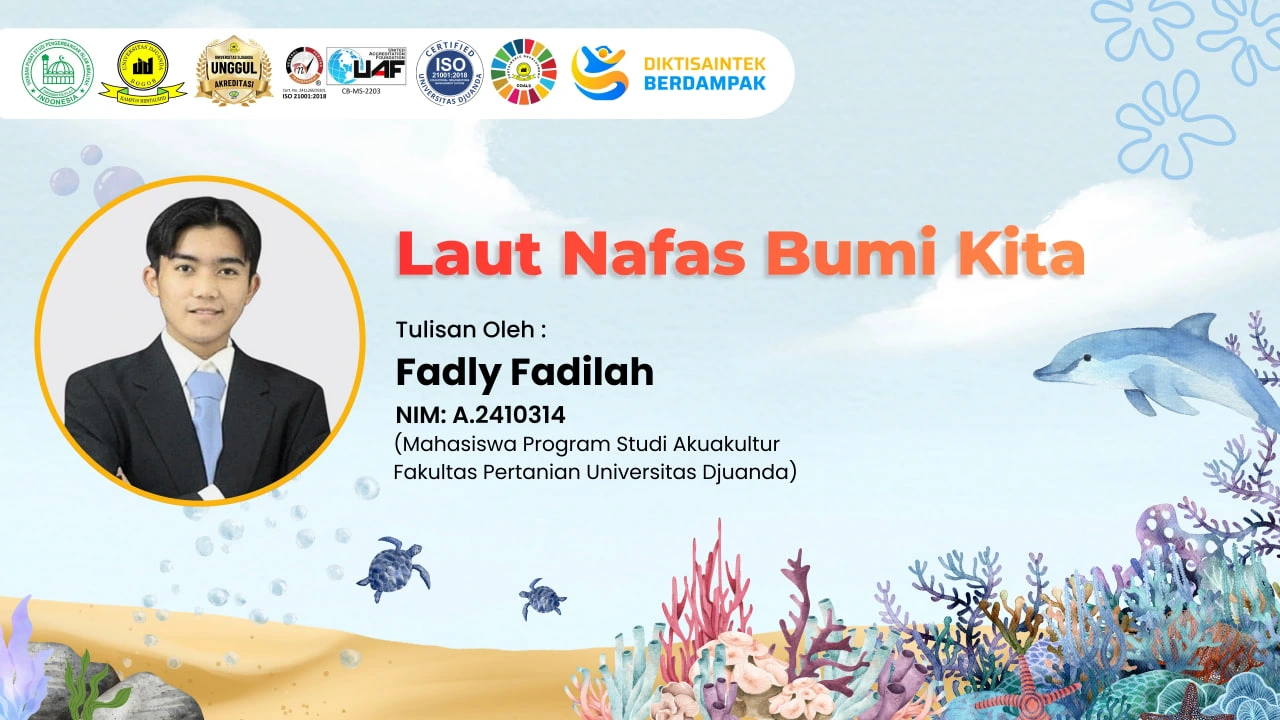
Fadly Fadilah
NIM A.2410314
(Student of Aquaculture Study Program, Faculty of Agriculture, Universitas Djuanda)
The ocean is one of Allah's extraordinary creations. More than two-thirds of the Earth's surface is covered by oceans that hold biodiversity, food sources, and invaluable natural resources. Within the ocean, there are millions of living creatures ranging from microscopic organisms to large organisms such as whales. All these living creatures live in a complex and beautiful ecosystem balance. In the context of human life, the ocean plays an important role as a source of animal protein, minerals, and industrial raw materials. Data from the Directorate General of Capture Fisheries stated in the 2023 Annual Report of Belawan Ocean Fishing Port mentions that the fisheries sector contributes more than 50% of Indonesian society's animal protein needs. Furthermore, the presence of marine phytoplankton is also able to absorb carbon dioxide (CO2) and produce oxygen through photosynthesis. The existence of diverse phytoplankton is also important as the foundation of the food web in the ocean, and will impact the sustainability and availability of other marine organisms. In other words, the existence of the ocean is not only important for fishermen or coastal communities, but also for all living creatures on Earth.
Behind all these benefits, the ocean also presents great lessons about the signs of Allah's greatness. In the Quran, Surah An-Nahl verse 14, Allah declares:
*"And it is He who subjected the sea for you to eat from it tender meat and to extract from it ornaments which you wear. And you see the ships plowing through it, and [He subjected it] that you may seek of His bounty; and perhaps you will be grateful."* (QS. An-Nahl: 14)
This verse explains that the ocean is not merely a food source but also a symbol of Allah's power and compassion toward mankind. Allah has subjected the ocean so that humans can benefit from it, seek sustenance, trade, and recognize the greatness of the Creator through the signs of nature. If viewed from a marine biology perspective, this verse depicts an orderly and sustainable life system. All elements in the ocean are interdependent: phytoplankton becomes the producer, then consumed by zooplankton which is subsequently eaten by small fish and large fish, forming a balanced food chain. This balance reflects the concept of "Tadbir Allah" - the perfect regulation of the universe. In Tafsir As-Sa'di, which can be accessed at https://tafsirweb.com/4362-surat-an-nahl-ayat-14.html, it is mentioned that "He is the One, who has no partner, 'who subjected the sea (for you)' and provided it for your various benefits." This verse serves as evidence of Allah's great blessing to mankind, as Allah has made the ocean easy to benefit from without humans needing to conquer it with their own strength.
This shows that the science and technology humans possess are actually part of Allah's Omnipotence, not the result of human power alone. Besides being a food source, the ocean also plays a role in maintaining life on land. For instance, coral reefs function as protectors of coastal areas by reducing wave force and providing a source of income for humans. Coral reefs also serve as guardians of biodiversity. In fact, the Natural History Museum mentions that the Great Barrier Reef contains more than 400 species of coral fish, 1,500 species of fish, and 4,000 species of mollusks. Apart from coral reefs, another important ecosystem is the mangrove ecosystem. This ecosystem acts as a protector of land from waves and tsunamis. The mangrove ecosystem is also a nursery and feeding ground for biota in surrounding waters. Without a healthy ocean, the balance of nature/marine ecosystems can be disrupted and directly impact humans.
Unfortunately, the ocean is currently experiencing damage due to human actions. Plastic pollution, industrial waste, and overfishing have become serious threats to the sustainability of marine ecosystems. Yet Allah has reminded us in Surah Al-A'raf verse 56:
*"And cause not corruption upon the earth after its reformation. And invoke Him in fear and aspiration. Indeed, the mercy of Allah is near to the doers of good."* (Al-A'raf: 56)
From this, we learn that protecting the ocean is not only an ecological obligation but also a form of worship and gratitude to Allah. Protecting the ocean means protecting sustenance, life, and the trust that Allah has entrusted to mankind. May we all play a role in maintaining this trust and protecting the ocean well, amen. Wallahu a'lam bishawab. (AQU.biola125)