
Last Updated: 7 months ago
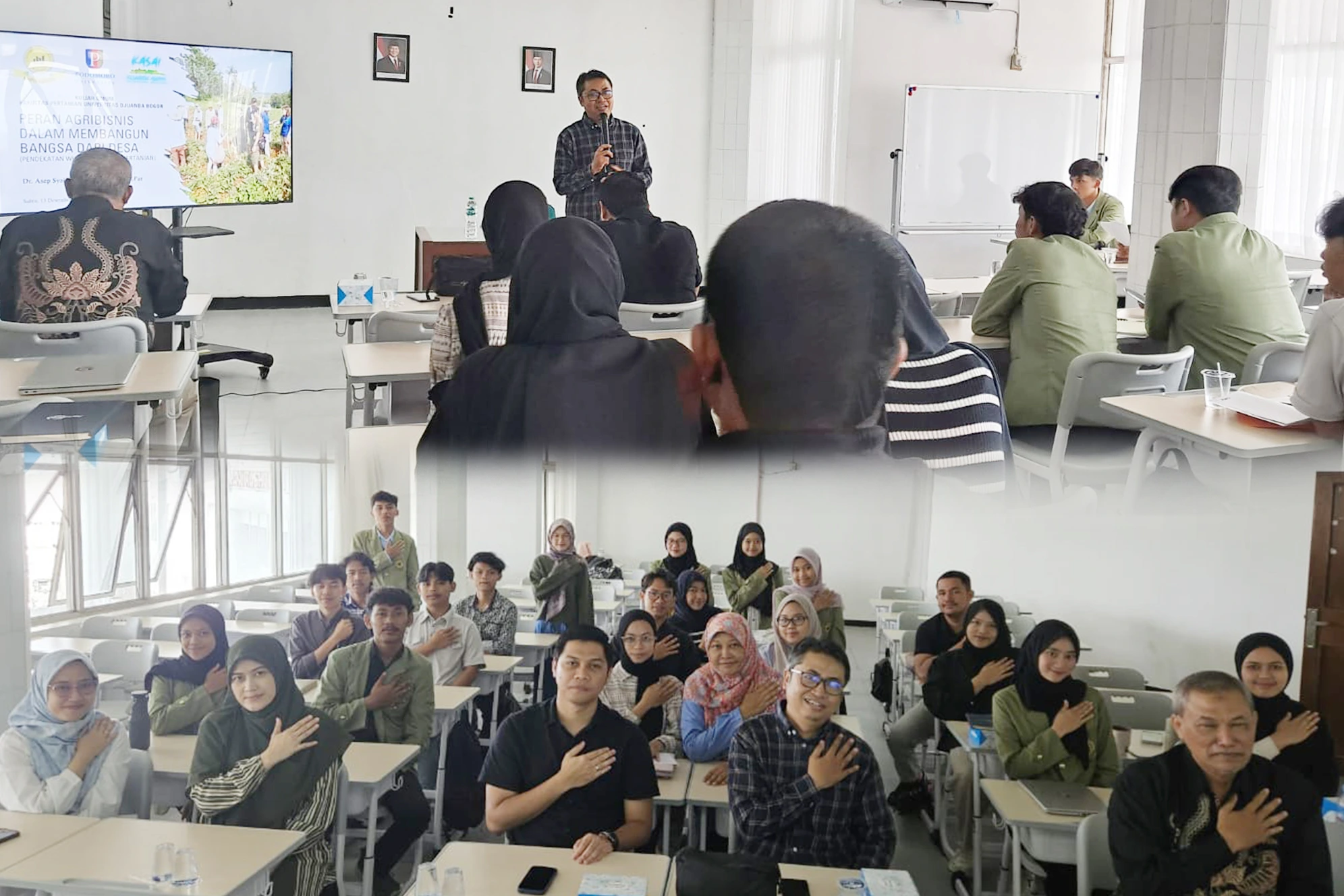
The Agribusiness Study Program, Faculty of Agriculture (FAPERTA), Djuanda University (UNIDA), held a guest lecture themed “The Role of Agribusiness in Nation Building from Villages” on Saturday (13/12/2025) at Classroom B.208, Building B, UNIDA Campus. The event featured Dr. Asep Syaiful Bahri, SP., M.Si., M.Par, an Agribusiness alumnus of FAPERTA UNIDA, who currently serves as a lecturer at a private higher education institution and as a practitioner and facilitator of rural tourism villages.
The guest lecture was officially opened with remarks from the lecturer of the Agribusiness Fundamentals course, Dr. Ir. Himmatul Miftah, M.Si, followed by the Dean of FAPERTA UNIDA, Dr. Abdullah Baharun, S.Pt., M.Si. The activity was attended by lecturers and students from several courses, including Farm Management, Agricultural Sociology, Entrepreneurship, Agribusiness Fundamentals, Cooperatives and Agricultural Institutions, and Strategic Management.
In his presentation, Dr. Asep Syaiful Bahri emphasized the importance of strengthening rural agribusiness through the development of rural tourism. According to him, agribusiness encompasses all agricultural business activities, ranging from input provision, cultivation processes, post-harvest processing, marketing, to institutional aspects, all of which can be integrated with local cultural values.
He explained that villages play a strategic role in national development. The majority of the population living below the poverty line resides in rural areas, while village-based agriculture serves as the frontline in maintaining Indonesia’s food security.
“Therefore, the agricultural sector must generate added value to remain attractive and profitable for farmers, one of which can be achieved through the development of tourism villages,” he stated.
Bogor Regency, widely known as a tourist destination, currently has around 70 tourism villages. Dr. Asep, who serves as a tourism village facilitator in Bogor Regency and was awarded Third Best National Tourism Village Facilitator in 2019 by the Ministry of Tourism, presented several examples of tourism villages, including Tugu Selatan Village, Sirnajaya Village, and Batu Layang Village.
Various rural tourism packages that attract visitors include activities such as producing kascing (vermicompost), planting and harvesting rice, processing agricultural products like rengginang, chips, and crackers, as well as enjoying local cuisine in farmers’ homes that function as homestays. Each activity is accompanied by explanations of cultural values and philosophies, creating a memorable tourism experience. The attractions offered include natural, cultural, and man-made attractions.
“The development of tourism villages can provide additional income for farmers and encourage rural youth to engage in the agribusiness sector. In this way, national food security can be maintained alongside improved welfare of rural communities,” he explained.
The lecturer of the Agribusiness Fundamentals course, Dr. Ir. Himmatul Miftah, M.Si, added that agribusiness has a very broad scope and can be developed in an integrated manner through the concept of agrotourism.
“Agribusiness covers activities from primary production to tertiary sectors. Agrotourism can be implemented at every stage of productive activities, allowing tourism village development to involve many actors within the village and promote more equitable economic distribution,” she said.
On the same occasion, the Head of the Agribusiness Study Program of FAPERTA UNIDA, Siti Masithoh, S.Pt., M.Si, expressed her hope that the guest lecture would strengthen students’ understanding of practical agribusiness implementation.
“Through this guest lecture, we hope that students will not only understand theory in the classroom but also gain real insights into the practice of developing tourism villages. This activity is expected to inspire students to actively contribute to village development based on local potential,” she stated.
Meanwhile, the Dean of FAPERTA UNIDA, Dr. Abdullah Baharun, S.Pt., M.Si, conveyed his appreciation for the involvement of alumni in academic activities within the faculty.
“We highly appreciate alumni who are willing to share their experiences with students. Guest lectures like this should be conducted regularly to strengthen the academic forum, enhance relationships between students and alumni, and build networks with the business and industrial sectors through experienced practitioners,” he concluded.