
Last Updated: 2 years ago
The Water Quality Management course is a mandatory subject for all students of the Aquaculture Study Program. This course equips students with fundamental principles of water quality management, covering physical, chemical, and biological aspects of aquatic environments and aquaculture water quality. One of the core sessions of this course focuses on understanding the theoretical concepts of water quality management and the factors affecting water quality. The aim is to ensure that aquaculture graduates are competent in managing water quality and its influencing factors.
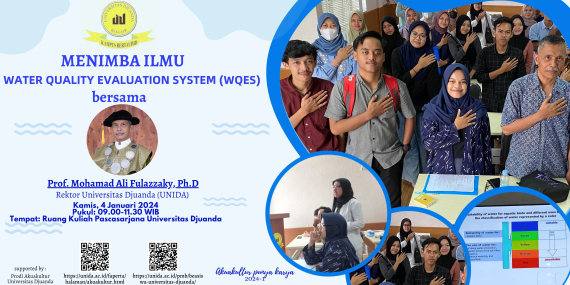
To strengthen the mastery of water quality management, the Aquaculture Study Program held a special session aligned with graduate competencies on the Water Quality Evaluation System (WQES) on Thursday, January 4, 2024, at the UNIDA Postgraduate Lecture Room. This session was delivered by Prof. Mohamad Ali Fulazzaky, Ph.D.
On this occasion, Prof. Ali emphasized that water quality management must be carried out in an integrated manner. Such integration is essential to achieve sustainable aquatic ecosystems. He explained that water quality assessment involves approximately 150 parameters. These parameters include:
Temperature
Color
Suspended Particles (SS, turbidity, etc.)
Oxidized Organic Matters (O₂, BOD, COD, etc.)
Nitrogen Compounds (NH₄⁺, NO₂, NTK)
Nitrate (NO₃)
Phosphorous Compounds
Mineralization (salinity, Cl⁻, K⁺, Na⁺, etc.)
Acidification (pH, dissolved Al)
Inorganic Micro-Pollutants for Raw Water (As, Hg, Cd, etc.)
Inorganic Micro-Pollutants for Bryophytes
Pesticides in Raw Water
Organic Non-Pesticide Micro-Pollutants
Microorganisms (thermo-tolerant coliforms, fecal coliforms, etc.)
Phytoplankton (algae, chlorophyll, etc.)
The lecture was attended by all students and faculty members of the Aquaculture Study Program. Students were very enthusiastic and engaged in an active Q&A session regarding the topic. It is hoped that the Aquaculture Study Program will continue to lead in advancing scientific knowledge in the fields of fisheries and marine science.