
Last Updated: 10 months ago
KKN students from Universitas Djuanda (UNIDA) in Cibalung Village, Cijeruk Subdistrict, Bogor Regency — a collaborative program between the Faculty of Agriculture and the Faculty of Computer Science — carried out one of their work programs by developing smart farming. This activity was conducted by a team of seven students (Firman WK, Elita NI, Syaqi AM, M. Rangga S, M. Risyad F, M. Abdul A, and M. Raihan AF) during the even semester of the 2024/2025 academic year.
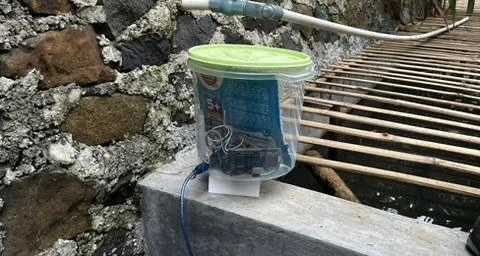
The project focused on the implementation of an IoT-based automatic fish feeder. The design was developed by assembling circuits on a breadboard, connecting a servo motor to the Arduino’s PWM pin, linking the RTC DS1307 module to the SDA and SCL pins, and attaching an LCD to the Arduino. A recycled jar was used as the feed container, equipped with a plastic spoon mechanism powered by the servo motor. A cardboard box served as the frame support. The main expectation of this implementation is to improve feed efficiency. In the long run, the project is envisioned to serve as a model that inspires other fish farmers to adopt more modern and efficient aquaculture practices.
The KKN group leader, Firman, explained that one of their programs was innovating an automatic fish feeder for local tilapia farmers in Cibalung. “The purpose is to assist farmers in the feeding process of their cultured fish. This serves as a practical solution to increase productivity in tilapia farming using tarpaulin ponds. The automatic fish feeder helps farmers provide feed consistently, effectively, and efficiently, while preventing delays, shortages, or excess feeding,” he said.
A local fish farmer, Mr. Ajat, expressed his appreciation for the innovation. “The automatic feeder is very useful for us. It is simple, easy to use, and can be applied directly to our fish ponds. I am grateful for this idea and solution,” he remarked.
The device has been tested and handed over to a tilapia fish pond in Cibalung Village. By combining Arduino-based electronics with recycled materials such as plastic jars, spoons, and cardboard, the students successfully created a functional prototype. It is expected that the automatic fish feeder will be used optimally and inspire further development of smart farming practices in aquaculture.