
Last Updated: 7 months ago
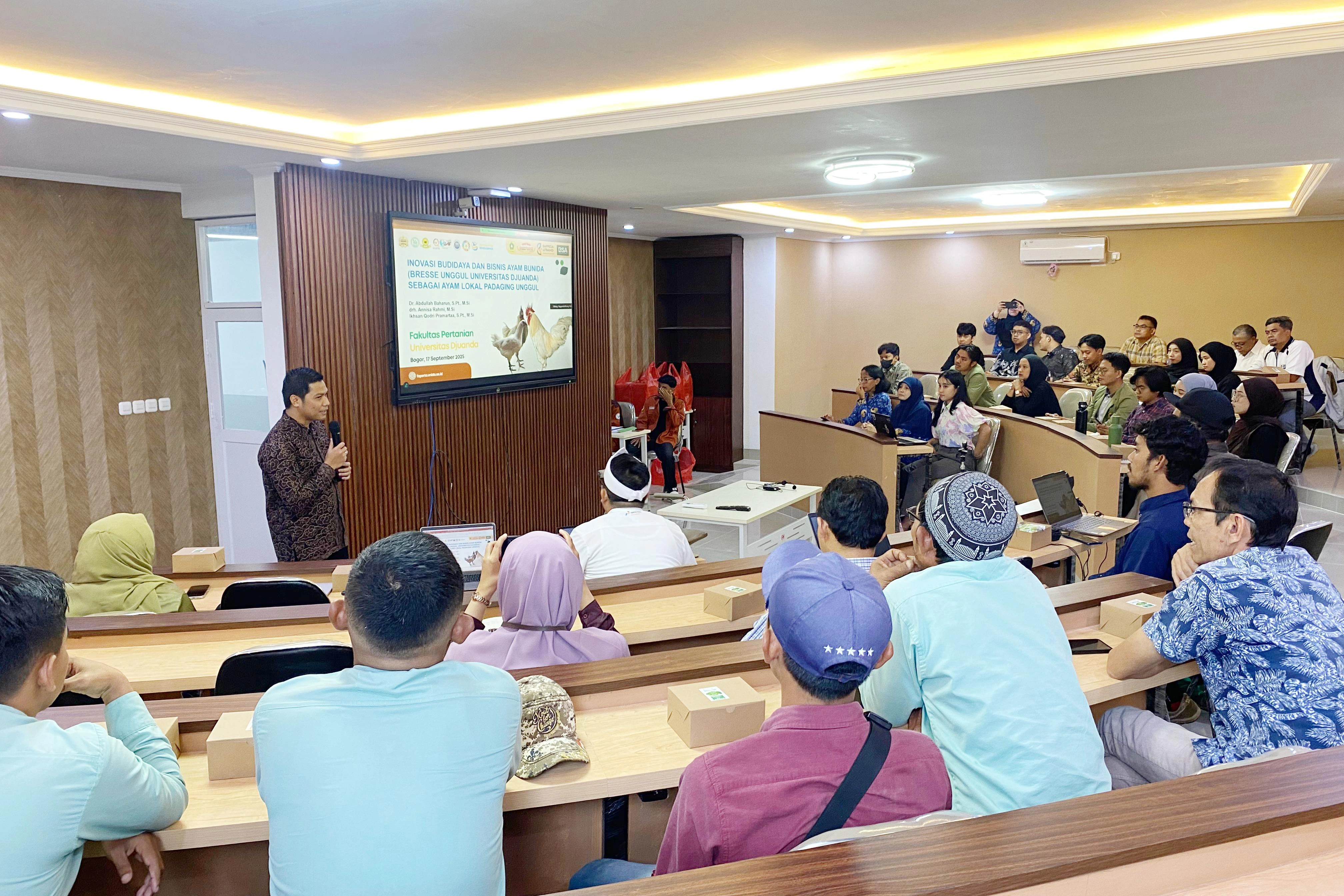
The Faculty of Agriculture (FAPERTA) in collaboration with the Regional Development Planning, Research, and Innovation Agency (BAPPEDALITBANG) of Bogor Regency held the Bogor Regency Innovation Diffusion event on Wednesday, September 17, 2025, at the UNIDA Graduate School Smart Classroom.
The event was attended by the Vice Dean for Academic Affairs of FAPERTA UNIDA, Dr. Abdullah Baharun, S.Pt., M.Si, who also served as a speaker, FAPERTA lecturer drh. Annisa Rahmi, M.Si, Head Researcher of the National Research and Innovation Agency (BRIN) Livestock Research Center Dr. Rantan Krisnan, S.Pt., M.Si, representatives from BAPPEDALITBANG Bogor Regency including Delima Hotmaria, S.Kom, Shinta Nasution, S.Sos., M.Si, and Iya Mulia, SE, as well as FAPERTA UNIDA students and local farmers.
In his remarks, Vice Dean for Academic Affairs of FAPERTA UNIDA, Dr. Abdullah Baharun, S.Pt., M.Si, explained that this collaborative activity can further support agricultural development, particularly in Bogor Regency.
“The BAPPEDALITBANG Innovation Diffusion is FAPERTA UNIDA’s commitment to transferring research results and agricultural technology innovations to the wider community, especially in Bogor Regency,” he said.
Meanwhile, Delima Hotmaria, S.Kom, one of the representatives of BAPPEDALITBANG Bogor Regency, conveyed that the event is expected to be an important momentum to strengthen collaboration between universities and local government, which can bring positive impacts for the broader community.
“Through this activity, we hope that the innovations developed can be implemented immediately and bring real benefits for agricultural development and the welfare of the people of Bogor Regency,” she stated.
During the presentation session, Dr. Abdullah Baharun, S.Pt., M.Si explained that UNIDA had successfully developed a superior local chicken line named Bresse Unggul Universitas Djuanda (BUNIDA), which won 1st Place in the 2024 Bogor Regency Innovation Award. This innovation was developed as a solution for food security and the empowerment of local communities.
He further explained that the third-generation (F3) BUNIDA chicken showed the best performance, with an average weight of 0.9–1.0 kg at 8 weeks of age and a carcass percentage of 63.04%. The fertility rate of its eggs reached 80.25% with a hatchability rate of 75.60%.
“BUNIDA chickens have an efficient FCR (Feed Conversion Ratio) of 2.20 in the F3 generation, with meat protein content reaching 20.15% and fat content only 1.84%,” he explained.
“Physically, BUNIDA chickens are characterized by plain white or white with brown patterns, black or white legs, bright red combs in males, and they produce white to off-white eggs,” he added.
According to him, BUNIDA chicken is the result of collaborative research aimed at creating a superior local broiler with fast growth and premium meat quality.
“With an FCR of 2.20 and protein content up to 20.15%, BUNIDA chicken has proven to be a high-quality and affordable alternative animal protein. The plasma partnership program we developed allows communities with no capital to engage in BUNIDA chicken farming through a profit-sharing system. In the future, we are committed to continuously developing BUNIDA and expanding its distribution network to support national food security,” he emphasized.
The second speaker, drh. Annisa Rahmi, M.Si, explained that the management system developed covers four main aspects: housing, feed, health, and reproduction, designed specifically for the characteristics of BUNIDA chicken as a high-economic-value animal protein source.
“The integrated management system we developed has proven to maximize the productivity of BUNIDA chickens in growth, reproduction, as well as premium egg and meat production. By implementing proper housing, feeding, health, and reproductive management, the genetic potential of BUNIDA chickens can be optimized to achieve productivity in line with their natural capacity,” she explained.
She also highlighted that with proper management, BUNIDA chickens can achieve optimal growth and higher egg production, which in turn increases farmers’ profits.
Meanwhile, Dr. Rantan Krisnan, S.Pt., M.Si, Head Researcher of the BRIN Livestock Research Center, explained that producing superior local broiler chickens is one of the strategic steps to enhance national food security. According to him, the development of superior local chickens will not only strengthen food security but also reduce dependence on imported chickens, which often face unstable price fluctuations.
“Superior local broilers have great potential to develop in Indonesia. Through proper research and technology, we can produce chickens that are more disease-resistant, more efficient in feed consumption, and have better meat quality. This will certainly bring great benefits to both farmers and domestic consumers,” he explained.
He emphasized that to achieve sustainable production of superior local broiler chickens, cooperation between researchers, farmers, and the government is essential. He also pointed out that the development of BUNIDA chicken is a concrete example of the success of university research in creating superior varieties with high economic value.
“BUNIDA chicken shows very promising potential as a superior local broiler with fast growth and premium meat quality,” he said.
He also expressed hope that with the technical guidelines disseminated at the event, local poultry farmers in Indonesia would find it easier to implement the right measures to produce high-quality local chickens capable of competing in the global market.